



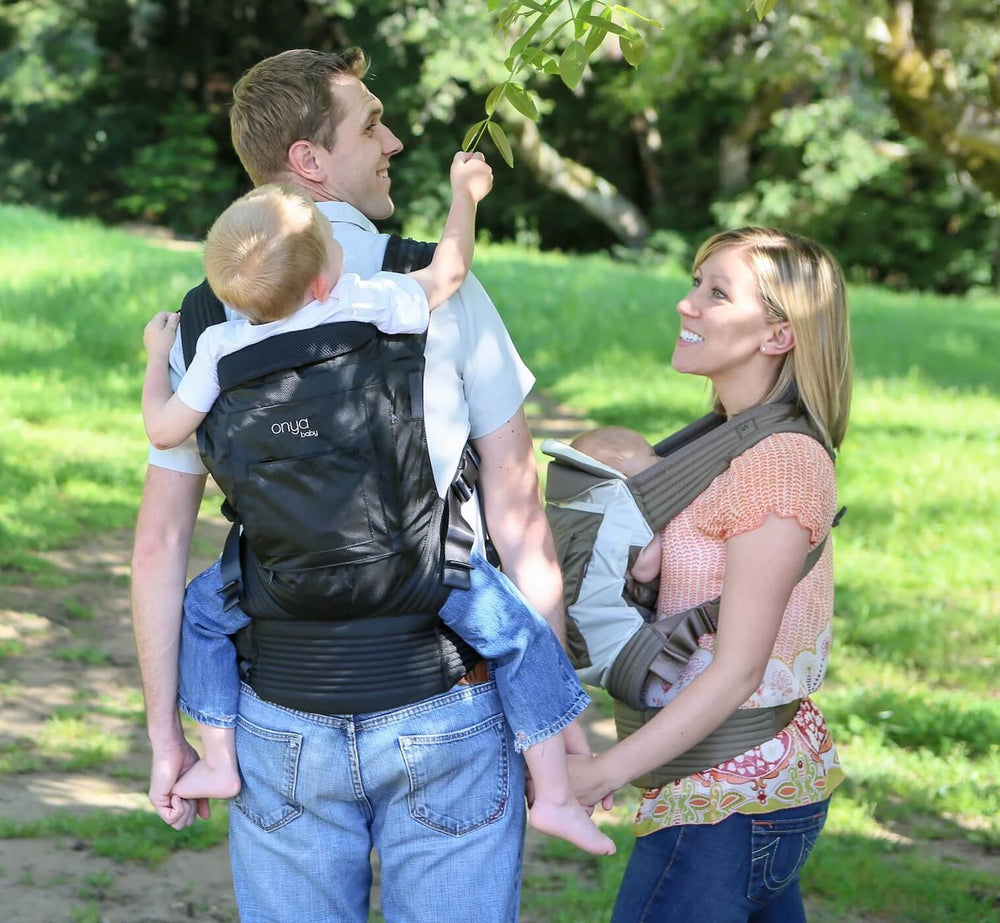
The Outback baby carrier: perfect for warm weather babywearing.

No Comments

Carrying your child in a sling, wrap or baby carrier has so many benefits, not the least of which is the ability to make your life as a mother or father much easier. As we know, it frees your hands and arms so that you can get things accomplished while still allowing you to keep your baby close and safe and exactly where your baby wants to be: with you. But what about when the weather warms up? What then?

Well, we’ve designed the Outback specifically to be cooler in hot weather. Both your baby and you will feel more comfortable when the baby carrier you’re using is made of material that’s highly-breathable, keeping you both cool as cukes.

Summer baby carrier Onya Baby Outback is cooler

The body of the Outback is constructed of durable, abrasion-resistant, mini-diagonal, rip-stop nylon coated on the inside with water-resistant polyurethane (PUL). The lining is the same as what’s used in cloth diapers, which mean it’s water-resistant while remaining breathable. The mesh inside lining is Air Mesh, which is polyurethane foam, topped with woven nylon. It’s highly breathable and wicks moisture away from your baby and you. You and baby stay cooler and drier. We designed the Outback baby carrier this way because it makes it lightweight, breathable and very durable. Onya Baby carriers (the Outback and the Cruiser) are designed to function like technical hiking backpacks, which can carry heavy loads comfortably for long periods of time. Your baby’s weight rests on your hips, not your shoulders. Your back, shoulders and baby will thank you for it!

Looking for a local babywearing retailer to go try one on in person? Check our store locator page.

 Tell us: how do you beat the heat while babywearing when the weather gets warmer?


National Sports and Physical Fitness Month: Grab your baby carrier and go!

No Comments

Babywearing is excellent weight-bearing exercise, and what better way to include your baby in your daily activities than by carrying them in a baby carrier? In honor of National Sports and Physical Fitness Month, we’d like to share some ideas and resources to help you get moving and active – and healthy – with your baby.

babywearing hike baby carrier

  • Get out there: Hiking with your children is a wonderful way to show them the beauty of their natural environment and get some great exercise at the same time. The sun, fresh air and your movement is sure to lift your spirits. Are you wondering where to find a local hiking spot? Here’s a helpful post that can help you do just that, no matter where you are.
  • Throw on some music and dance around your living room, your bedroom, your kitchen while you cook…wherever you are. All you need is your baby, you carrier and some music. What’s another bonus, aside from the great exercise you’ll get from moving? You might find that the music and your movements put your baby in a good mood, too. You might even end up with a sleeping baby. And we all love a sleeping baby, don’t we? Oh, and yes, we have a post about that, too.

Check out these great sites for babywearing exercises and other goodies:

How about you? What do you do to get moving with your baby?
Happy Babywearing!

Earth Day everyday: three easy things you can do to be eco-friendly

1 Comment

We all know how precious this planet is and, if we want to do something good for our children and for our children’s children, then we only need to think a little about how we use the resources that we have. But we also know how busy life can get and no one wants to add complication to their lives. So, with that in mind, we put together a list our of three easy things (plus a bonus one) you can do to be eco-friendly and keep your home safe for your little ones.

Cleaning: opt for effective and inexpensive baking soda and vinegar. The combination is amazingly effective at cleaning everything fromtop eco-conscious choices kitchen appliances and counter tops to your bath tub and shower. Make a paste of baking soda and water will get your silver sparkling again. Add baking soda to your washing machine as a laundry booster. It works well as a deodorizer, too. So, go ahead and sprinkle some in those stinky gym shoes, garbage can, or Kitty’s litter box! Check out this page for some amazing things that baking soda can do. Follow the links to learn more about the cleaning power of vinegar. They’re truly amazing, multipurpose cleaners.

  • Shopping: Choosing to use re-useable cloth bags when Eco-conscious tipscarting home your shopping is an easy and effective way that we can all help to keep unwanted plastics out of our landfills and use fewer paper products. Another bonus? Cloth shopping bags tend to be sturdier than their plastic or paper counter-parts, meaning you’re less likely to end up with a broken bag and spilled contents all over the place. With so many choices of reusable shopping bags on the market, you’re sure to find ones that work well for whatever you’re toting home. Keep a stash of them in your car for your grocery days, or keep one or two of the kind that tuck up into themselves in your bag or purse so you never forget them. Just be sure to run them through the wash every now and again to wash out any bacteria and keep them both clean and green!

Water use: We all have to do it, don’t we? The never-ending laundry and dishes need to be cleaned. What’s super easy and effective at cutting your household use of water? Simply waEco-conscious eco-friendly go greeniting until your laundry or dishes loads are large enough to fill the washer before running the wash. This not only will cut down your overall water consumption, but it will also make your lives a little easier by giving you fewer wash loads to load, run and unload. Of course, we also know that simply turning the taps off when we’re doing things like brushing our teeth or taking shorter showers are also easy and effective ways of reducing our water use.

  • Bonus tip: Stop your idling car. If you’re going to be in place for more than a minute or so, simply turn your car off. This saves gas and lowers your car’s emissions. It’s easy and effective. And it will save you money. What’s not to love?

How about you? Do you have any tips you’d like to share?

Happy babywearing!

If you liked reading this post, you might also enjoy these related posts: Seven Steps to a Healthy Nursery, Top 5 Eco-Friendly Baby Care Tips.

Image sources (from top):
http://www.ivillage.ca/living/home/30-ways-clean-naturally-SR
http://www.vtworksforwomen.org/blog/bags/
http://blog.michellekaufmann.com/?p=1038

Evolution, parenting and babywearing…

1 Comment

Evolutionary parenting: why babywearing makes sense.

carrying a baby close keeps the baby safe and mother able to use her hands

Picture it: you’re in your cave, snuggled in the warm furs and leaves of your bedding with your family sleeping around you. Your baby, tucked in the nook of your arm, nurses at your breast. You sleep together, keeping each other warm during the cold winters, and you know where each child is during the night. But now, as the sun begins its morning ascent, you must arise to begin the work of the day. There is food to gather, prepare and store. The cave must be cleaned to keep scavenger animals away. You take your square of hide and your strips of leather thong and tie your baby to your back to begin your day. Your baby is now safe with you and you’re ready to roll. Time to get moving…

______________________________________________

If we look at babywearing, which is defined as the practice of wearing or carrying a baby in a sling or in another form of carrier (1), from an evolutionary perspective, it simply makes sense. As a practice, it crosses cultures and spans millennia. In its most functional form, babywearing is simply the most practical way for a caregiver to transport a baby, particularly over uneven terrain. Long ago, during the dawn of our days as hunter-gatherers, mothers needed a way to keep their babies safe and close while they completed the tasks of daily survival. A baby left alone is a baby in potential danger.

A baby left alone is helpless; completely dependent upon his caregivers to care for and protect him. Human infants aren’t the only primate babies to need close care-giving, but they are the least developed at birth, physically and neurologically. Chimpanzees, our closest primate cousins, can a baby is safest in a baby carrierhold onto their mother shortly after birth. This not only allows the primate mother to go in search of food and shelter, but it also allows the mother to have her hands free to move about, gather food and climb while keeping her baby close and safe. In contrast, for many months following birth, human babies aren’t able to grasp with the strength needed to hold onto their mothers. No baby is safe when left alone at a very young age, no matter the species. Carrying her baby in a sling or baby carrier is the most sensible solution for the human mother, whose baby has no other way to remain attached to her while she moves about as needed. This was true in the dawn of humanity and continues to remain true today.

Humans and primates alike rely on caregivers to care for their young, but human infants are especially helpless. Not only are human infants physically dependent upon their caregivers for survival, but their brains are also comparatively underdeveloped. “By one estimation a human fetus would have to undergo a gestation period of 18 to 21 months instead of the usual nine to be born at a neurological and cognitive development stage comparable to that of a chimpanzee newborn.” (2) In other words, “children have a very long developmental period, relative to other comparably sized mammals and primates, and are highly dependent on adult caregiving.” (3) In many cultures, “mothers are the principal caregivers, providing extensive body contact day and night and prolonged breast-feeding. When not carried, the baby of hunter-gatherers has complete freedom of movement. Care is consistently affectionate, with immediate nurturant response to crying. Nonetheless, in most groups, children achieve early independence and by 2 to 4 years spend more than half the time away from the mother.” (4) During the time of hunter-gatherer groups, early independence was vital to the group’s survival. Children would, as soon as they were capable, would be expected to assist in the duties of daily survival. The child’s familiarity with daily activities, which would have come from being carried on the mother’s front and/or back, would serve the child, the mother and the group as a whole, because the time to teach the child his duties would be lessened than if he had been kept separate from daily life.

Babywearing makes sense through evolution. Paleo baby

Another important way that babywearing makes evolutionary sense is that it helps calm babies. Babies who are carried often are calmer and cry less than babies who are not. (5) In the dawn of humanity when humans lived in much closer proximity to predator animals then we do now, the cry of a baby had the potential to attract hungry predators. A baby is instinctively tuned to cry when left alone for this evolutionary reason. We are born with a deep-seated biological and evolutionary need to be held as infants because it is the very safest place for a newborn baby to be. When the baby is on the mother, she’s also closest to the mother’s breast, a constant source of nourishment and comfort. In addition, the close contact also serves to regulate the baby’s body temperature and aides in “reduced stress, enhancement of mother-infant bonding, and positive effects on the family environment and the infant’s cognitive development.”(6)

From an evolutionary parenting perspective, the benefits of the placement of the baby on the mother makes deep biological sense. It’s deeply ingrained in our evolutionary practices as humans as a natural response to having babies and the need to keep them close. This is why, for so many babies and so many mothers (and, increasingly, fathers) it just feels right.

If you wear your baby, you’re in good company; connected through the ages by our shared history as mothers, as humans. Welcome to the club.

Happy babywearing!

______________________________________________

References:
1. Babywearing – Wikipedia. Link
2. Wong, Kate. “Why Humans Give Birth the Helpless Babies.”  Observations, Scientific American Blog Network, August 28, 2012. Link.
3. Bogin, B. “Evolutionary hypotheses for human childhood.” Yearbook of Physical Anthropology, 40, 63–89. 1997
4. M.D. Lozoff, Betsy, M.D., Brittenham, Gary. “Infant Care: Cache or Carry.” The Journal of Pediatrics, Vol. 95, Issue 3, 478-483. September   1979.
5. Hunziker, Urs A., Barr, Ronald G. “Increased Carrying Reduces Infant Crying: A Randomized Controlled Trial,” Pediatrics, Vol. 77, No. 5. 641-648. May 1 1986.
6. Charpak, N., Ruiz, J.G., Zupan, J. et al. “Kangaroo Mother Care: 25 Years After,” Acta Paediatrics, Vol. 94, No. 5. 514-22. May 2005.

Image sources:
Chimpanzee baby and mother

Esquimaux of West Greenland engraving

Seven Steps to a Healthy Nursery

No Comments

Seven Steps to a Healthy Nursery
A guest post by Stefanie Gomez

Setting up a baby’s first nursery is an exciting activity for many new parents. Some parents decide to co-sleep or share a family bed with their baby for the first months or years of their baby’s life, while others opt to set their baby’s nursery up right away. Regardless of when parents decide to give their baby their own room, nearly all parents want to make their baby’s room a safe haven. There are some common conventional hazards that you can avoid when it comes to home furnishings and décor.  What are some top concerns and recommendations for new families?

Here are seven tips to help you set up your baby’s room to be a happy and healthy nursery for your baby’s comfort and your piece of mind:

Eco-baby has an eco-friendly nursery1. Choose a paint for the nursery that’s free of Volatile Organic Compounds (VOCs). Traditional interior paints release harmful vapors into the air long after the paint has dried and the smell has dissipated. Ventilation may help the paint dry faster, but any section of the wall that is exposed to sunlight will continue to produce harmful off-gassing. Choose a VOC-free paint and let it dry completely before decorating the room. The good news? VOC-free paint is becoming more widely available and, in turn, more affordable. Good news indeed!

2. When selecting furniture for your nursery, make sure the manufacturer has chosen to use VOC-free paint as well as VOC-free adhesives. Toxic adhesives and other chemicals, such as formaldehyde, are often used in the production of furniture, particularly when it’s constructed of plywood, particleboard or Medium-Density Fiberboard (MDF). If possible, invest in furniture constructed of sustainable wood and painted in VOC-free paint so that it won’t negatively impact the air quality of your home. Check with the manufacturer to find out what adhesives were used in the production of their furniture. If possible, buy furniture early and allow it to off-gas in a well-ventilated place prior to placing it in your baby’s nursery.

diaper your baby in cloth diapers for a healthy baby and healthy nursery3. Think disposable diapers are chemical-free? Think again. Most conventional disposable diapers are composed of bleached polyethylene fabrics and high-absorbency polymers bonded by a variety of adhesives. Not only do these diapers tax the environment by using non-renewable resources to produce and many years to biodegrade, but they also contribute harmful vapors and polymers. We understand the convenience of disposable diapers, just choose an eco-friendly disposable diaper when you need or want to use ‘sposies, and cloth diapers when you can. Your child and the environment will thank you for it.

4. Plastic bins to hold items and supplies may be affordable and convenient, but they can contribute to a poor indoor air quality. Over time, plastics begin to decompose and even flake off small particulates that can be trapped in dust and inhaled. When possible, opt for wicker or bamboo natural baskets, both of which are constructed of sustainable materials and can be recycled when you are finished with them.

5. From teeteco-baby gets natural eco-friendly toyshers to building blocks and teddy bears, you need to know everything about the toys that you bring into the home. Look for a product safety report on the brand and the article prior to buying. Having a baby shower? Ask everyone to make environmentally aware choices that will support your healthy home when purchasing gifts for your child.

6. Choose an organic crib mattress for your child. The difference between conventional mattresses and organic ones in terms of price may be a matter of a few hundred dollars, but if your bedding is convertible (the type that will grow with the child) it is wise to invest in an organic mattress that is not bleached. Choose a natural latex or thick 100% cotton topper to prevent stains and leaking.

7. Be sure to use non-toxic cleaners in your baby’s nursery and when cleaning your baby’s toys. Many conventional household cleaners contain harmful chemicals that your baby will breathe in and ingest if used in and around the nursery and home. Read labels carefully and refer to an excellent resource, such as The Environmental Working Group’s Guide to Healthy Cleaning. Another great (and easy!) option? Make the cleaners yourself using non-toxic and inexpensive ingredients such as white vinegar, baking soda, lemon and borax.

Healthy living can some in baby steps or giant leaps. It might be an way of life already or ways in which you’re working to improve. We all count, and our collective choices are what can positively impact our world, our children’s world. We have the poser to to make any number of small changes in the products we purchase. Cumulatively, the choices we make add up and can prevent conditions or health complications, over-use of our precious resources and, ultimately, a better ecological future for our children, for our children’s children. Your choices, large and small, make a difference. Arm yourself with information and shop wisely. We can all do what we can. We can all our best. For our children. For their children. For us all.

What do you think? Are there any tips that you think we should add?
Please comment below to let us know!

Happy babywearing!

 ———–

About the author:

Stefanie Gomez is associated with Essentia, manufacturers of the world’s only natural memory-foam mattresses. She is a self-proclaimed internet enthusiast and shopaholic. She is eco-lover who love to research and write about healthy and sustainable living options. Stefanie contributes to the Essentia blog, as well as many other platforms. Connect with her here.


Image Sources (from top):
1. http://www.sesshudesign.com/blog/truly-zero-voc-paint-for-healthy-indoor-air/
2. http://www.telegraph.co.uk/news/features/3636325/Quite-interesting.html
3. http://www.etsy.com/listing/97405609/lilypad-eco-friendly-natural-felted-wool